Sunday, 28 August 2011

Obs: Comfort Zones

What do you do when you can't figure out what your character should be doing in a scene? Well, the most important thing is knowing what the character's objective is. Everyone knows that.

But let's explore something more global, something that affects us in all scenarios and pretty much all the time. Today's observation is about comfort zones. This is something that should be considered on-top-of our character's objectives. Take for example, our character wants to eat some pie but there are spikey obstacles in the way. Our character won't be running across it to get to the pie if it's going to hurt him or cause him discomfort. Ok, that's quite an extreme case but this can be really effective if used in more subtle ways.

In the biological sense, our body is always finding ways to use the least amount of energy possible and to be as comfortable as possible. Say you're at home and sat down watching TV. A few minutes later, you'll find that your body is completely slumped. And if you get any lazier, you'd fall asleep. Biologically this makes sense because we need to conserve energy for when we need it - in the case of danger. Similar reasons to why our heart beats faster when we're afraid, to make sure our body is ready to flee or fight. So the next time you're animating a character doing an action, it's useful to think about how "comfortable" they are. It helps add that bit of realism to your piece doing things that people naturally do.


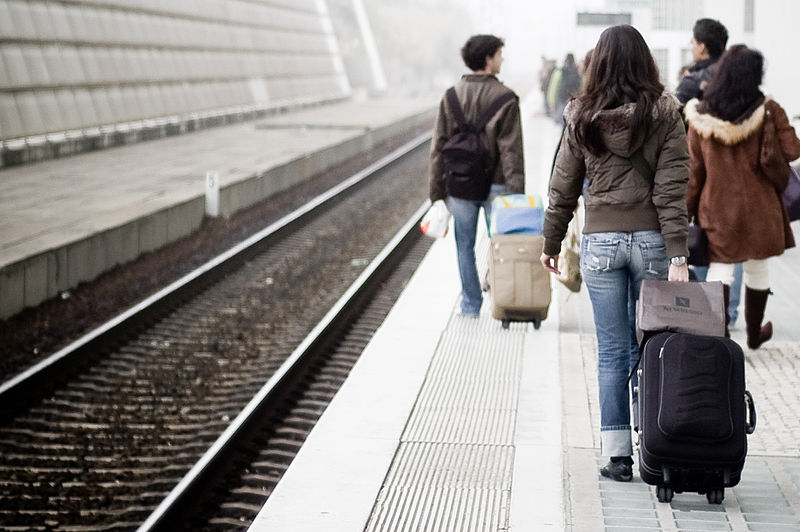
We also move in reaction to our comfort zones. When someone we don't know or don't like moves too close to us, we move away. This is best observed at the bus stop. When there are few people at the bus stop and you're stood on one side of the bus stop and another person comes up right next to you, chances are you'll feel very uncomfortable. The funny thing is that your comfort zone is adaptable depending on the situation. If the bus stop was packed with a lot of people, and you are sandwiched between others, it becomes acceptable because everyone else is in a similar situation. 

The more we understand about what makes us or our characters comfortable or uncomfortable will help make our character's interaction with others in the scene a lot more believable. So the next time you make your animation poses, ask yourself if it looks comfortable in etiher a) as a normal balanced pose or b) comfortable in the situation.

Apart from the main objective that our characters are going through, do remember that there are also a lot of subconscious things that our bodies will do naturally to support our actions. The more we observe the nonverbal clues of body language, the more we can accurately display genuine actions for our characters. I used to believe secondary action is something you add to your animation for extra awesome sauce. It's not. It's something you consider before-hand and apply consciously throughout your animation for all the right reasons. 

Friday, 15 July 2011

First Class Honours!

I just received my degree results from my University today.

I got a Bachelor Of Arts in Digital Character Animation With First Class Honours! Can't be more pleased about this. It's time to celebrate with some sushi.

Monday, 11 July 2011

Anim Test: Bucky


Found this Buck Kid rig and decided to have a play with him. Just an animation test done in 2 hours.

Thursday, 16 June 2011

Obs: Blinks


Have you ever spoken to someone about something and for some strange reason, you are able to tell when he/she starts getting confused/don't-have-any-idea-what-you-are-talking-about? Apart from the obvious confused look on their faces, and their stillness in their body language and/or pause in their activities, notice that they will also stare at you blankly. By this I mean they will stop blinking. Weird isn't it?

There are a lot of reasons why and when we blink but I think this one is quite interesting in it's own right and I'd like to talk a little about it. Seems blinking is also an activity linked with absorbing information. To me it's the nodding of the eyes. When you're listening to someone and you are in agreement, you tend to nod at them... and blink too! I know this seems odd, but try it for yourself. An example is when I am in a lecture hall and listening to a very informative and interesting lecture, I would catch myself blinking a lot. I mean a lot uncontrollably.

I believe the same is true when you stop agreeing. This is why it's quite shocking how we are able to tell when someone is lost while trying to explain something to them. It's easy to tell because we notice a change in behaviour or a break in a pattern. While the listener understands what you are talking about, they will often be blinking, nodding, etc and suddenly as they get confused, our brains are able to detect that change in behaviour, a different action performed out of the normal, even as subtle as fewer eye blinks. Try it and see for yourself!

Monday, 6 June 2011

Started work at Cubic Motion

Today was my first day working at Cubic Motion. It was great. Lovely place, people and atmosphere. And already a lot of work to be done. I think I'll be very busy the next few months! Wish I could talk about the exciting projects I'm going to be working on but it's top secret.

That's all for now!

Tuesday, 31 May 2011

Obs: You look at what you want


Observation: You look at what you want. For the most part, this is very true - where your eyes are looking will determine what is currently in focus or of interest. You can pick up many things from looking at people in the train station, bus stops, etc. Most people who travel alone like their own space and mind their own business. Many will resolve to mp3 players with headphones plugged in or reading books. These people tend to have their eyes down and away, often signifying their desire to not be disturbed and left in their own little worlds.

Then there are others who are without any media distractions, travelling alone with nothing to do. Observe them. You can tell a lot about a person by looking at where they are looking. If their eyes are constantly scanning the room, their brains are active, they are receptive to their surroundings and are alert. Perhaps hoping to meet the gaze of another interested individual. Generally, if you're looking around you or at people, you're opening yourself up for conversation and subconsciously inviting friendly talk. If your gaze is down and away, it's the eye language equivalent of "leave me alone". Of course these are all variable depending on the situation but I'm just talking about general observations here.

As I was travelling in the train one day, I caught myself becoming a victim to this observation. I'm usually either reading, scanning people, reading them or when I'm tired, look away in a corner and try to fall asleep. What was unusual in this instance was that I needed to use the toilet. First thing I did was try to identify where the nearest toilet was without getting up. It was at the end of the corridor. Next I determined whether or not it was vacant without getting up so I studied the light switch above it. I couldn't really tell if it meant vacant or not.

What I did notice was 2 other ladies sat uncomfortably near the toilet with quirky movements. It told me they were waiting for the toilet. Soon I realized I was no longer doing the things I would normally do, lie in a corner or falling asleep. I was constantly checking for the toilet to be available, scanning the area, seeing if the ladies had already had their turn. So much so that my body had tilted itself to a unusual position, my head leaning to the side  giving me full vision of the situation in front of me. This got me thinking. Would I have been in this position if I hadn't needed to use the bathroom? No. It was an uncomfortable position, with my head tilted to one side and heck why would I be staring at the aisle in front of me for? At which point, I got a little subconscious because I thought the ladies in front caught my eye and they must be thinking the same thing, "this guy needs the loo". Hah!

Naturally I tried to fake it and look away returning to a more comfortable position. But it was difficult to go back to doing something more casual when you really needed the bathroom. I soon found myself back to the original leaning position, with my eyes on the toilet scenario.

Have you ever had a conversation with someone and suddenly their eye darts to something behind you and eventhough he/she is still talking, you know they are now focussing on something else? More often than not, you'd be so intrigued by what has intrigued them that you too will turn and see for yourself. Our eyes can be so revealing sometimes.

This ends my observation for "You look at what you want". Your eye looks are directly connected to your brain and will look at what you are currently interested in. So I guess this is why we look at people's faces when talking to them (mostly eyes) to read them because it is shocking what you can find out with their gaze and direction.

Wednesday, 25 May 2011

Watery eyes part 2

Ok, I wrote the last post in a bit of a hurry and have had some time to reflect on it since.

I think I'll format these observation posts in a more meaningful manner next time, starting with my main point and then elaborating on it based on my experience.

Here we go!

General observation: Some elements of emotional state can come from the design/look of the character and does not always rely on the animation itself.


Specific observation: Watery eyes/redness is a powerful tool that can be used to make your character appear sad/in-tears.

As an animator, I've always had to rely on my animation skills to push the emotional state of the character and to find ways of making him connect with audiences through movement. The truth is, this skill - as valuable as it is to an animator can only be taken so far. The fact is there are also a lot of contributing factors that can help make the character/scene more convincing.

Take shot layout and camera movement for example, the primary factor of how we connect to an audience is surprisingly overlooked by many animators. A well placed camera and/or controlled movement can have more of an impact than you think. A slow zoom into a character often helps the audience connect to the character better, often used when the character is in deep thought for example. The animation could be the best in the world and incredibly subtle perhaps, but if the camera is in a full body shot or a long shot; the effect is completely changed.

Colour design and theory will also add to how we feel about the characters/scene. The scary thing is how our brains pick up these clues so unconsciously that we take them for granted. This is certainly an area I would like to explore further when possible.


Following the colour design, lighting also plays an important part. Having a character very well lit or not can mean so much in ways I can't even describe. There are many examples out there of how good lighting affects the mood and atmosphere that you can probably look up.

Character design helps tell us who these characters are that we are animating. With just a generic default character rig, it tells us hardly anything. Why is this important? Surely a well animated character can shine without fancy designs. That may be true but again, as I mentioned above, there is only so much you can do with animation. These are plusses, bonuses, add-ons, icing on the cake, if you will to not only make your animation stand out but more importantly help the audience connect better with your animated character. A good design will immediately establish a good understanding of your character before he is even moving. Is he a cowboy? Is he a waiter?

The generic rig tells you very little about the character
Customized rigs tell you more about the character and their personality

I suppose the goal of every shot is to immediately tell the audience the story, the scenario and what's happening in just the scene layout/designs itself. That way, when the audience watches the animation, they spend less time figuring out who these characters are, where they are, what time it is, etc and spend more time concentrating on what's important - what's actually happening in the scene.

Ok, I appear to be drifting off topic now. OH yes, back to my main point, the watery eyes and the impact! I guess this new found discovery made me realize a new factor that can contribute to the performance!

I'm not actually sure what category this will fall in to be honest, maybe under character design? It's just additional things we can do to make the performances more convincing. In 3D, with good rigs, we can often use squash/stretch, rotations, translations and even scale to deliver our performances. Now that I've discovered this watery eye concept and how much it affects the character's looks, it really got me thinking just how much more of these little details I've missed out.

I know this isn't anything mind-blowing or new in 2D, because I've seen many great examples of 2D animation where they include a ton of details but a lot of which are only possible due to the nature of the art form. 2D is great because you can make anything happen, a transforming character, deformations, eye pops, explosions and what not all limited to just your imagination. With 3D however, it is a lot more work to get those results and as such 3D characters tend to have that rigidness.

Can you think of other examples of what we can do to push the characters designs further apart from maybe changing the colours of the eyes?

Watery eyes


So I only just got up a few minutes ago, and as my eyes got a little watery from the morning wake, instead of wiping it off with my hands, I squeezed my lids shut. When I opened them (while in front of the mirror), and as my eyes and its surrounding areas become moist, it almost becomes inevitable that I had to blink a lot more and it stung a little. I do like to act in front of the mirror sometimes, and in this case, I pretended to shed a tear or be sad.... what I found was shocking. It took such little effort to sell this emotion when you have watery eyes!

When your eyes are watery, it seems you'd naturally blink more anyways and that adds even more to the whole sad/insecure emotional state. I tried a couple of different things like smiling and wiping a tear and the result was spectacular. It was all on-top of the in-tears emotional look which I could not hide regardless. Seems the watery eye look is just that powerful. As much as I tried hiding it, it just appeared as if I WAS consciously trying to conceal it but still appearing sad.

I think I'll try this again in future to see what more I can get from this!

Monday, 23 May 2011

Jobs and Summer plans


I will be working as an animator at Cubic Motion in Manchester, UK from June to October 2011. Then I'll be starting my animation internship at Framestore in London, from November onwards.

I have also officially finished with my final year at Teesside University studying BA Digital Character Animation. Over the last 4 years of education (including placement year), I have been very active in improving my skills and practicing. Often so much so to the expense of my social life which is a little sad. It has however paid off with jobs and fantastic opportunities :). I want to take it a bit easier this summer and make up for lost time. Go out a bit more, enjoy the sun, meet new friends, spend less time in front of the computer for a change!

Of course this doesn't mean I'll stop learning or being productive - no no. If and when I do have the time, I would like to return to the basics of animation and start nailing those animation principles down to the core to strengthen my basics. I have been tackling a lot of advanced acting and performance related animation recently and as much as I love doing those, I feel I've been neglecting my basics a little bit. So you can expect some mini animation exercises and tests in future. I'm also keen on tackling some creature animations in preparation to my time at Framestore.

Quite recently I've joined Linkedin - click to see my profile and add me if you know me!

I'll try and post a bit more as well. I have many animation questions, theories and observations that I've been meaning to post about. Until next time, keep your heads up and happy animating!

Monday, 25 April 2011

CCA Animation Complete!


Watch in 720p HD
Watch in 1080p Full HD

Above is my completed animation for my Creative Character Animation module at Teesside University. The cool thing is it only took me about a week! You can follow the development blog for this here. Big props to Josh Burton for the amazing Morpheus Rig! Love the facial controls on this one, very extensive!